Posts mit dem Label Solitaire gaming werden angezeigt. Alle Posts anzeigen

Montag, 15. Februar 2021

A Gentleman's War plus 30mm flats = a new SYW ruleset?


Another rule set - intially bought just for reading and collecting purposes, because I had seen many other tabletop bloggers mention it, but now that I'm reading it I find it looking a lot more playable and deep than I thought: A Gentleman's War by Howard Whitehouse.

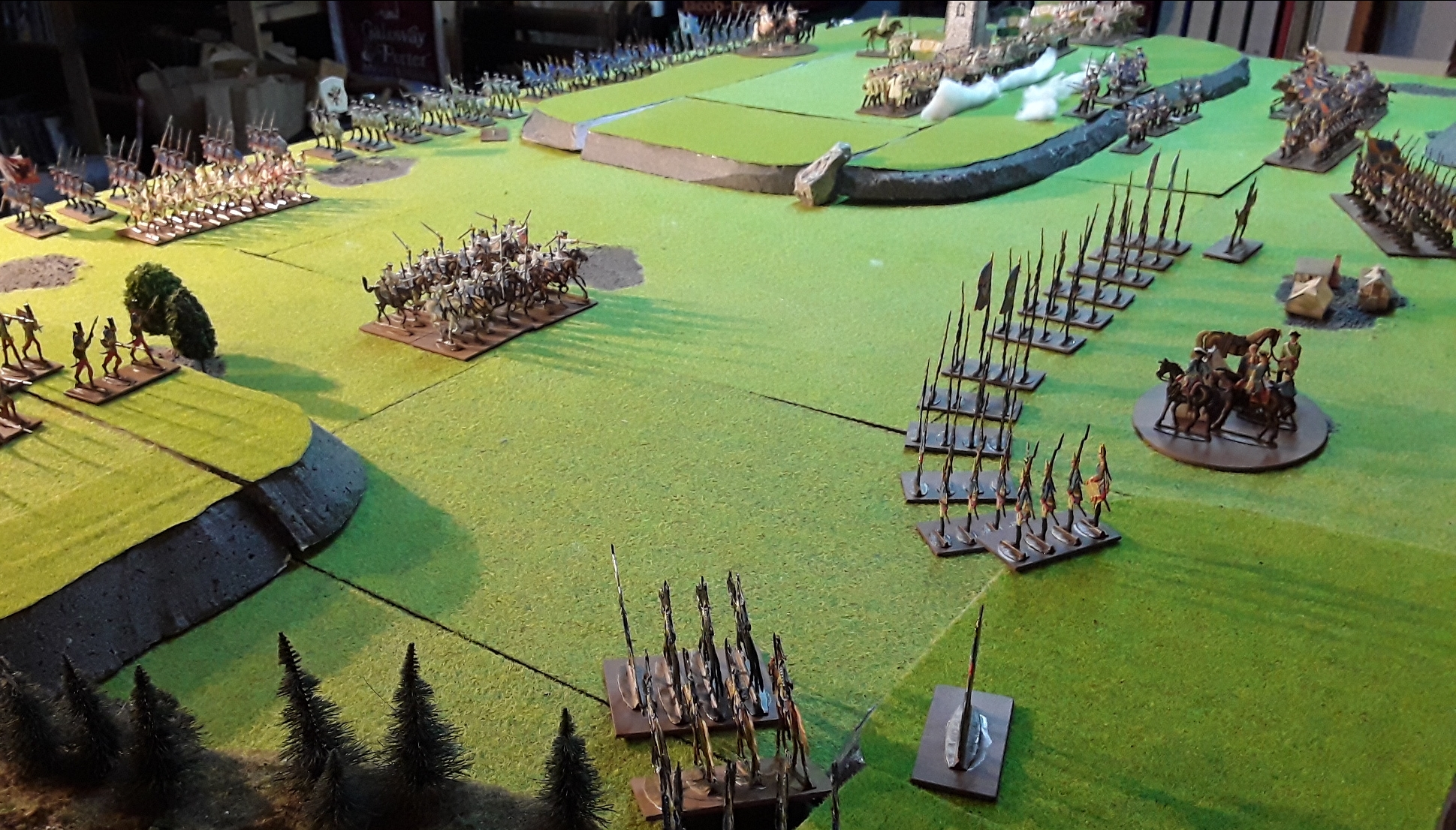
I'm thinking of using it with my 30mm flats - not exactly the old school toy soldiers used by most of the community around that game, but very much in spirit of the game regarding the origin of the minis, and, in my case, also the paint job (examples here).

The rules are written with late 19th century armies in mind (pre-WWI uniforms for color, meaningful battlefield roles for rank-and-file infantry and cavalry, but also first appearances of modern trappings like machine guns). However, they include a variant for 1700-1850 with adjusted shooting values for firearms etc.

I intend to try this 18th century version of the rules with my Seven Years War armies (Empire vs Prussians) from my Zinna project. In this post I want to outline my first ideas for adjusting rules and OOBs to fit my armies.

1. Unit and army sizes


The number of units in my current OOB is pretty much in range of the medium-to-large scenario size from the Gentleman's Rules.

There are two major differences regarding unit size, though:

A factor of two

My units have 24 infantry, 16 cavalry and two guns per battery. This happens to be twice the number of minis as assumed in the Gentleman's rules (12 man infantry and 6 man cavalry and skirmisher units). 

I see a few ways to deal with this:

1) run the units as they are and apply the rules as written, i.e. usually roll about twice the number of dice for each shooting or combat phase. 

2) run the units as they are but treat each pair of minis as one figure in the sense of the rules. In other words, count only the front rank for game purposes and set up the second rank for visual effect only.

3) run rules and units as written, i.e. just keep the minis I normally use in the second rank off the table.

Option 3 is not so attractive, because I have my minis grouped with four models per base, and a 12 man unit with three bases will not look nice in the two-ranks setup assumed in the rules. I could go to with single rank units (as in some other games, Fields of Glory and Blucher (?) come to mind), but I have to admit that the visual appeal of two rank units is much, much higher in my eyes so I would always vote for option 2 over 3.

I think I will try both options 1 and 2 and then see what feels better. 

I expect that option 1 would push combat results towards the average, i.e. closer melee outcomes and less frequent "doubled" results. It would make combat more attritional, which is not really historical for SYW melees (although it might be ok for firing). Plus the larger amount of dice thrown will make it feel even more like the "buckets of dice" approach taken by the Games Workshop universe of tabletop games, and that's not a plus for me, to put it mildly. 

On the other hand, marking and removing casualties will not get any easier in option 2, given my multi-man bases.

Individual unit sizes

The other detail is that most of my cavalry units are based with 4 minis per base (and 4 bases per unit), so no matter what option I choose from the above list I will not get to a clean representation of 6-man units.

I don't want to mess about with any complicated calculation rules to make my 8 (or 16) man units behave like 6, instead I think I will just run them as 16 man units (option 1 from the above), and add a points value relevant Distinction of "Large Unit" and +1 point to reflect the larger size.

The other related detail is that I have different numbers of minis on the bases for the light infantry (Austrian Grenzers, Prussian Freikorps). 

In option 1, that would mean light infantry units are a little smaller than normal line units (not sure whether this is worth some compensation points-wise - 12.5% less sounds less critical that 33% more as for the cavalry). 

In option 2, it would be a bit tricky - maybe the unit could be considered a 10 man unit, but I don't like it. Another strike against option 2.

In option 3, this one would again be easy: Freikorps and Grenzers would have 12 man and 9 man units. In this case, the 9 man units might deserve a discount vs line (or a points increase vs 6 man skirmishers). Or I just use my 6 bases per battalion as 3 small 6-man skirmishing units.

Oh, and option 2 and 3 would be really nice opportunities to use my 6 man Wunsch Jäger Frei-Company. In option 1 this would be a bit more strange as it would correspond to a tiny 3-man unit in the normal rules.

2. Unit characteristics


The thing that got me thinking that Gentleman's War might work with my SYW armies was that the concept of unit specific distinctions and deficiencies seems perfectly suited to the asymmetric nature of my Zinna armies - the small, highly professional and efficient Prussian army vs. the more sluggish, less eager and very mixed bunch of Empire units, with their huge variations of performance between units and over time. 

Here's a first shot at my unit characterizations, based on solid half-knowledge of a non-academic armchair historian:

1. Prussians

Category Specials Pts Notes Current OOB
Grenadiers Brave, Gallant, Well Drilled, Marksmen 10
2 battalions
1st line infantry Gallant, Well Drilled 81) 4 battalions
Freikorps infantry Light infantry, Swift 6 2)2 battalions
Freikorps Jägers Sharpshooters, Marksmen, Tiny Unit 2 3) 1 company
Cuirassiers Large Unit 6 4) none yet
Dragoons Large Unit 6 4, 5) 1 regiment
Hussars Large Unit 5 4) 1 regiment
Field artillery none 4 4) 1 battery

Total points value for my current OOB (incl. the last Zinna units currently on the workbench): 20+32+12+2+6+5+4=81

1) I won't distinguish Fusilier vs Musketeer units. I think that's more about hats than about performance - worn out units need different treatment, see Empire below.
2) Use minor benefit "swift" to balance the minor drawback of "small" unit size
3) Use good firing ability as partial counter to the "half" unit size in options 1 and 2
4) Nothing special about Prussian cavalry
5) Treat Dragoons as heavy cavalry (they are not the kind of mounted infantry shown as Dragoons in Gentleman's War - their SYW role was shock cavalry, just without metal breastplates)
 

2. Empire (incl. some Austrians)

CategorySpecialsPtsNotesCurrent OOB
ElitesGallant7Grenadiers
2 converged battalions
1st line infantrynone6High qualityHessen-Darmstadt; Kurpfalz Guard
2nd line infantryPoor Drill5Default "average"
I/Kurmainz, Württemberg, I&II/Baden-Baden
Battle weary / worn outBrittle, Nervous4As per previous battle(s)II-IV/Kurmainz (badly mauled in the last Piquet game)
Green / mixedPoor Drill, Timid4Mixed units w/high fluctuationErnestinisch-Sachsen, Ferntheil
Habsburg GrenzersLight infantry,  Stalwart, Swift 7"swift" balances "small"2 bat. Karlstädter-Oguliner (21 minis each)
Empire Heavy CavLarge Unit, Nervous5tbcHohenzollern Kürassiere, Ansbach Dragoons
Austrian HussarsLarge Unit, Swift6tbcNadasdy
Empire Field artillerynone41 Franconian battery

Total points value for my current OOB (incl. the last Zinna units currently on the workbench): 14+12+20+12+8+14+5+5+6+4=100

Sonntag, 20. Dezember 2020

Gaslands: zweites Rennen


Nach dem ersten Testrennen mit mehr Ausfällen als Autos im Ziel dachte ich, es den Fahrern mit einer lockereren Startaufstellung leichter zu machen. Jeder durfte sich (in Platzierungsreihenfolge des Vorrennens) mit beliebigem Abstand zu den Vordermännern aufstellen um Platz zum Durchstarten zu haben.

Trotzdem war es wieder deutlich chaotischer als erwartet.

Startaufstellung. Einige Wagen lassen absichtlich mindestens eine mittelschnelle Gerade Abstand zum Vordermann.
Trotz der lockereren Startaufstellung sah es nach der ersten Kurve schon gleich relativ durcheinander aus. Mehrere Fahrzeuge haben schon die ersten Dreher hingelegt. 
Rechts oben sieht man die ersten Fahrzeuge, die sich etwas absetzen konnten: vorneweg der silberne Survivor Racer, gefolgt vom Warrior Buggy und vom Street Victor. Die Sportwagen der Speedsters (der silberne Lambo und der metallicblaue Fantasiewagen) schleudern hin und her und fahren mehr rückwärts als vorwärts.
Nach und nach können sich mehr Autos aus dem Startchaos lösen und in die Rennphase übergehen. Der führende Survivor Racer schleudert allerdings nach einem Fahrfehler quer über die Strecke und blockiert den Buggy. Hinten ist der Lambo mit Totalschaden ausgeschieden, der blaue Sportwagen bezahlt den Preis für seine elegante Überlänge und rangiert endlos herum bis er wieder in Fahrtrichtung schaut.
Der silberne Survivor Racer rangiert noch, als die ersten beiden Wagen schon im Ziel sind.
Abschlussreihenfolge von links nach rechts.

Ergebnis des Rennens:
  1. Warrior Buggy - 15 Punkte 
  2. Street Victor (Porsche Spyder)  - 10
  3. Green Warrior (Audi 200) - 8
  4. Taxi Warrior (Audi Quattro) - 6
  5. Indie Victor (Chevy Camaro) - 5
  6. Survivor Racer - 4
  7. Survivor Truck (Chevy Silverado) - 3
  8. Speed Racer Fast Fuse - 2
  9. Speeder Lamborghini - DNF
Fahrerwertung nach zwei Rennen
  1. Buggy Warrior 30
  2. Green Warrior 18
  3. Taxi Warrior 16
  4. Street Victor 10
  5. Survivor Truck 9
  6. Indie Victor 5
  7. Survivor Racer 4
  8. Speed Racer Fast Fuse 2
  9. Speeder 0
Manmschaftswertung nach zwei Rennen
  1. Warriors 43
  2. Survivors 20
  3. Victors 15
  4. Speeders 2

Gaslands: Intro und erstes Rennen


Beim Stöbern in meinem Lieblingsspieleladen bin ich über Gaslands gestolpert, ein Autorennspielmaus dem Osprey-Verlag, der seit einiger Zeit außer historischen Büchern (Uniformen und so) auch verschiedenste Tabletopregeln herausbringt.

Bei diesem Spiel geht es um Autorennen mit Autos im Matchboxformat, die in einem postapokalyptischen Science Fiction Setting in der nahen Zukunft (hmm, wo hab ich das denn in letzter Zeit schonmal gehört?) stattfinden. Dabei wird nicht nur gefahren, sondern auch fröhlich gerammt und mit fast unbegrenzt schwerer, optionaler Bewaffnung herumgeballert.

Eigentlich hab ich mir das Regelbuch wie oft nur zum Lesen und aus allgemeiner Neugier gekauft, aber dann dachte ich ich probier es doch mal aus.

Einige der Bewegungstemplates für niedrigere Gänge und mittlere Geschwindigkeiten

Ich wollte erstmal eher das Fahren ausprobieren, regeltechnisch mit verschiedenen Schablonen für verschiedene Fahrtgeschwindigkeiten und Gänge abgebildet. Ich hab daher die Bewaffnung auf das Minimum reduziert (Handfeuerwaffen für alle Passagiere) und den Schaden davon noch weiter reduziert (nur Hazard-Token statt richtigem Schaden mit Ausnahme des zweiten bei einer sechs auf dem Schadenswürfel).

(klicken zum Vergrößern) Teamliste, erstellt mit dem Gaslands Refuelled Team Builder von Luke Philipps 

Um im Alleinespiel etwas Gefühl für verschiedene Strategien zu kriegen, hab ich mir vier Teams mit verschiedenen Autos und Fahrstilen ausgedacht: 

  • die Warriors, die erstmal den Gegner weghauen und dann übers Gewinnen nachdenken
  • Kult of Speed: Sportwagen die einfach Gas geben ohne nachzudenken
  • Victors: Gewinnen, egal wie
  • Survivors: härter sein und länger fahren als alle anderen, dann gewinnt man auch

Weil die Begrenzungen der Rennstrecke aber aus soliden Felsen waren, gab es trotzdem jede Menge schwere Beschädigungen wegen Fahrfehlern etc. Schon auf der Startgeraden war das Chaos perfekt, weil einer der Wagen schon beim ersten geradeaus-Beschleunigen ins Schleudern kam und fast allen anderen den Weg versperrte. So endete das Rennen über eine einzige Runde mit fünf Ausfällen von neun Wagen.

Die Sieger des ersten Rennens - die fünf restlichen Autos erreichten nicht mal das Ziel. Klarer Sieg für die Warriors auf Platz 1-3.

Ich hab mir gedacht eine Rennserie mit Punkten pro Rennen zu fahren. So was wie 15-10-8-6-5-4-3-2-1 Punkte für die ersten neun Autos, und dann mit Fahrer- und Mannschaftswertung. Um unterschiedliche Anzahlen von Autos pro Mannschaft auszugleichen, gilt für die Mannschaftswertung immer das beste und schlechteste Ergebnis (auch wenn letzteres Null ist wegen Ausfall).

Durch die vielen Ausfälle im ersten Rennen ergibt sich eine sehr einfache erste Fahrerwertung:

  1. Buggy Warrior im Fahrer A - 15 Punkte
  2. Green Warrior im Audi 200 - 10 Punkte
  3. Taxi Warrior im Audi Quattro - 8 Punkte
  4. Survivor Truck im Chevy Silverado - 6 Punkte

 Und als Mannschaftswertung

  1. Warriors - 23 Punkte
  2. Survivors - 6 Punkte
  3. Kult of Speed und Victors - 0 Punkte


Mittwoch, 4. November 2020

Slow-Mo Piquet: Game 4, the story without the die rolls


As for previous Piquet games (here and here), after detailed game logs with all initiative pips and die rolls which are more for my own reference, I also want to post one summary with the story of the battle as it evolved.

You can click on the pictures to see a larger version, as always.

The previous two battles were kind of meeting encounters between retreating troops and the vanguard of the pursuers. This time I wanted to go for a classical linear battle, as outlined in the setting.

So as planned, the first few turns here and here were spent marching the armies on the table in long march columns organized by wings. 

The Empire received an extra move card as part of the army characterization, and were allowed to march on the table in two parallel columns. Although the Prussians stole a march on them in turn one with a timely heroic action, overall it began to show soon that the Empire would be deployed into line formation before the Prussians were ready. 

At the end of turn three, the Empire infantry on the right are already starting to form into line formation while the infantry intended for the Prussian center are still marching (dangerously close to the enemy cavalry in front of the villages on their side). On the Prussians far right, the skirmishing Frei infantry keep the deployed line of three Kurmainz battalions in check.

As you can see in the picture above, the Empire's Ansbach Dragoons are closing in on the Prussian infantry center while they are still in column of route. The Dragoons wasted no time and brushed one Prussian Fusilier battalion off the table with a quick charge. 

On the left and in the center, the Empire had formed line before the Prussians did, but got stuck in a fruitless firefight and, eventually, in a fatal attack where two (!) Kurmainz battalions were pushed back by the skirmishing Wunsch Frei-infantry, one of them even routing off the table in total disarray.

The protracted firefight on the Empire left. Frustrated because they completely failed to impress the opposing skirmishers, the Kurmainz battalions charge and are beaten back soundly by Wunsch.

In the center (as on the unfortunate left) the Empire is evolving its columns into line formation ahead of the Prussians, with the reformed Dragoons holding the Prussian Hussars at bay.

Things are very crowded, though, as the Empire struggles to develop two mutually supporting lines.

A view of the Empire center, which is actually getting crowded as the Empire reserves already advance to take pressure of their unlucky left flank units. The Croats have advanced to the tip of the hill on the Empire right.
The Ansbach Dragoons try to force another hole into the still forming Prussian line, but are thrown back by the Malachovsky Hussars who cause a one base loss with a timely counter attack.

The situation after the cavalry clash on the Empire right flank
In turn 6, there is general fighting along the line, but mostly inconclusive fire back and forth. 

Then, the cavalry fight on the Prussians left flank escalates, with Malachovsky Hussars charging Ansbach Dragoons, routing them but breaking itself on the Empire Grenadiers behind the Dragoons. 

Prussian left wing after the cavalry fight - Ansbach Dragoons are runnimg off the table at half strength, Malachovsky Hussars have been wiped out by fire from the combined Kurmainz and Ernestinisch Sachsen Grenadiers.
On the Prussian right, the skirmishing Wunsch Freikorps continue their unbelievable heroics, routing a Kurmainz batallion in a very close melee (tied die roll resolved in favor of the attacking Prussians). 

The skirmishing Wunsch Freikorps watch their opponents turn from "line" into "run" formation

The resulting gap in the Empire's left flank, and even more in its depleted morale chip pool, essentially forces the Empire to retreat despite all of its valiant efforts and local victories. 

I have played out a little bit of that retreat, and it might be fun one day to complete a retreat until all losing units are off the table, but here the Empire line was still organized enough, and the Prussians so cautious, that it didn't seem worth the effort and I ended the game a few initiative rolls after this.

Empire troops are beginning to retreat, Prussian infantry advances cautiously as the Empire center still has full strength battalions firing at them.

Learnings for future games

I had to relearn most items from the last game:

  • cav units (not just elites) would have counted as two for army size determination - with my growing army sizes this is getting relevant as armies will get over the minimum three card allotment
  • cavalry charging skirmishers does not have to wait for cav move, they can attack on an (opportunity?) pip
  • movement in III/IV also allows all units more than 12" from an enemy to move (and all movement cards allow formation changes to such units). This is important if I play out the marching into battle.

And I ran into one new complication: I got confused how many morale chips can be lost in one melee. 

I saw some weird corner cases, like the Prussian battalion losing a melee by a factor of three (routing it) but with very low die rolls (few bases lost), so they were off the table with fewer chips lost than some Empire units who remained on the table and rejoined the fight after rallying, but lost multiple chips in high-roll, close results. 

For some time I thought there should be at most one morale chip loss per lost melee, not multiples for losing, becoming disordered, stand losses etc. But rereading the rules it seems clear that these chip losses add up, so a single unit with one or two unfortunate melee results can eat up five or more chips. Somehow this means that even if they remain on the table and not routing, a small number of damaged units can ruin the whole army's morale. 

I'll try to make myself believe that is historical until the suspension of disbelief fails even worse in future games. 

Montag, 5. Oktober 2020

Slow-Mo Piquet game 4: turn 6 - End


Turn 6 (let's say 10:30-11:00 a.m.)

Sequence decks: Prussians remove one card for the routed Fusiliers and one for the poor command. Empire remove one card for the routing Kurmainz battalion.

Phase 1, roll 1: 11:12, Prussians turn dud.

Roll 2: 14:5, 6:3 pips

Empire turn dud, reload, use it on 4/Kurmainz and fire them at Wunsch once more, D10 d1 disordered, u1 pb, d2 target skirmishing for D6:D6, 2:3 no effect.

Then turn skirmish move and move the Grenzers towards the wooded area on the very left of the Prussian flank, and turn Officer check (with no need to test anything).

Prussians turn difficult move (not usable for marching anymore as all units are within 12" of an enemy), dud, cav move.

Roll 3: 16:10, all remaining pips are split 7:3.

Empire move their HQ to the right, turn cav move, retreat the Dragoons, turn dud, heroic moment for elite reload. Fire the converged grenadiers in the center (despite long range) at the Hessen-Kassel Fusiliers at D10 up1 1st fire, d2 long range, D8:D8 for 3:7 no effect.

Prussians don't charge their Hussars into an even D4:D4 cav melee, instead turn - another cav move :(, and an infantry move. Use that on their reserve first.

Phase 2, roll 1: 18:20, Prussians don't move the center and right wing infantry and turn cav melee and dress lines instead.

Roll 2: 18:19, Prussians turn cav move.

Roll 3: 13:10, 2:1 pips.

Empire reload and fire the Grenadiers again, this time D6:D8 without 1st fire: 2:7 no effect.

Prussians hold back on the cav move and turn Officer check instead, with no need to roll for survival.

Roll 4: 18:18, the heroic elite reload for the Empire goes unused.

Turn 7 sees the same sequence deck changes as before.

Phase 1, roll 1: 5:1, 3:1 pips

Empire turn useless deployment, dud, dud (2 art moves...). Prussians turn dud, too.

Roll 2: 10:2, 6:2 pips.

Empire turn officer check, don't need a survival roll, try to bring the Dragoons back in command: D20 d1 disordered, d1 enemy within 1 move for D10:D8, 7:6 success. Spend a pip and a morale chip to rally the Dragoons D6:D8, 4:4 fail.

Empire then turn difficult move and use it on the Grenzers on the very right. Then turn dud, dud.

Prussians turn dud, diff. move.

Roll 3: 3:7, 1:3 pips.

Prussians turn reload, fire and reload Wunsch at 4/Kurmainz, at D10 u1 pb range, d1 disordered, 4:3 for no effect. Then turn inf move.

Empire turn dud.

Roll 4 for 3 remaining pips, 1:7. 

Prussians move their reserve, turn cav melee, refill their 4th opportunity pip.

Correction

Looking at the morale chip situation, I think I penalized the Empire troops to highly for their lost melees. Multiple chip losses for one melee seem overly harsh and, rereading the table in the Cartouche rules on morale chip losses, unwarranted. I think I need to return at least two chips for the Kurmainz unit and one or two for the Dragoons. Before rereading the rules and blow by blow, I'll return 3 chips to make it 8:15.

Phase 2, roll 1: 14:9, 4:1 pips

Empire turn cav move, skirmish move and use it on the Grenzers, turn inf move.

Prussians turn command decision (at one of the best possible times...)

Roll 2: 1:17, 12:3 (only 15 pips left)

Prussians turn dud, cav move, melee (choosing not to melee their skirmishers), reload. Fire the skirmishers at D10 d1 disordered, up1 pb, D10:D6 for 6:2, OOC. Reload and fire again, 6:1 just missing a better effect.

Then turn officer check and attempt to rally the Hussars at D20 d1 disordered, d1 rally, d1 enemy within 1 move for D8:D8 7:2 ok. Note they can't be brought under command as cav that left a mixed command.

Then turn skirmish move, but find their skirmishers are already in melee (and thus probably couldn't have chosen to skip their melee some time ago...). So turning continues with a useless maneuver, difficult move, and then a cav move.

Empire first rout their 2/Kurmainz, then move their reserve and right wing.

Phase 3, roll 1: 7:12, 1:4 pips.

Prussians charge and melee the disordered Dragoons with their Hussars. Hussars fight with D6, d1 blown, up1 charging, the Dragoons fight with D8 d1 blown, d1 -1 stand, d2 disordered for the minimum D4. Roll is 6:4, one more stand loss, Dragoons rout. Empire lose a morale chip (not multiples as I played earlier), Prussians get two bonus pips. The Dragoons rout through the Grenadiers who turn unformed. The Hussars are disordered, and roll to prevent pursuit D20 d1 disordered, d2 prevent pursuit, d1 one move range for D4:D8, failing the check 1:7. So they pursue the Dragoons 6 inches, hitting the Grenadiers on the way. 

As elites, the Grenadiers fire a volley (their first!) at point blank range, D10 up 1st fire, d1 unformed, up1 range, D12:D6, 4:1 for 1 stand loss.

Prussians then turn infantry move. They move their reserve. Next they would like to advance the right infantry wing to move Hessen-Kassel through their retreating skirmishers and attack the spent 4/Kurmainz. However, the Wunsch Frei infantry is stuck in melee and will have to fight first. They do that on the last available pip, attacking their disordered enemy without a card and with D8 up1 charging, d2 disordered, d2 skirmish = D4 vs D8 d2 disordered =D4, 4:4 tie broken in favor of the attacker, routing the Mainz infantry.

Another Kurmainz battalion turns tail and runs, routed by the fearsome Wunsch skirmishers. 

Rereading the rules on morale chip losses I think these are cumulative, after all. I don't quite get it, because this treats a unit routing unralliably after a one stand loss in a 4:1 result much easier than a unit that loses two stands and rallies later, but whatever. I will remove the three morale chips from the Empire again which I corrected earlier, remove one from the Prussians for the Hussar stand lost to fire, and now 3 more from the Empire for losing a melee and routing with a 1 stand loss, so they only have a single chip left.

Empire use their one pip to let the Grenadiers melee the Hussars who pursued into them in disorder: D8 up1 charging, vs D6 down lots for disordered, lost stands etc. D10:D4, 9:1, the Hussars are wiped out for a chip loss of 1 (lost melee) +3 lost stands. Not sure another chip makes sense for routing the non-existing unit, but I'll award it to keep things a bit more interesting.

The Empire right wing is now devoid of cavalry - Ansbach Dragoons are runnimg off the table at half strength, Malachovsky Hussars have been wiped out by the Kurmainz and Ernestinisch Sachsen Grenadiers.

Roll 2: to be cont'd...

... or not? Looking at the morale situation with 1:8 chips remaining, I guess all that is left is a withdrawal of the Reichsarmee. I guess I'll first have to pass a player morale check before I play that out.

So let's take stock. At the moment, unit losses relevant for a major morale check would favor the Prussians. Although they have lost two units completely (one Fusilier battalion and the Hussars), the Prussians currently have three routing units and only one morale chip, i.e. one chance to rally one of them. The Empire would have to tie the Prussians by rallying one Kurmainz battalion, or routing another Prussian unit anywhere, to avoid their next Major Morale check.

Currently, this check would be a D20 having to roll >1, but only if there is a morale chip left to pay for that (so no more rallying for now). I guess the odds to make the first roll are ok, but as soon as the Empire loses a morale chip to something else their army will crumble quickly.

So the best the Empire can do is beat a fast and efficient retreat. I don't think I'll play that out, but will start to see how quickly things go south. So the goal is: don't spend pips on anything but retreating and maybe occasionally firing off a lucky salvo at the pursuing Prussians. Let's try that.

So Roll 2: 19:16, Empire turn a heroic... cav move to forced rout their Dragoons off the table.

Prussians advance their right wing and withdraw the heroic Frei infantry.

Roll 3: 11:17, 2:4 pips.

Prussians fire at their right wing opponents. 1/Hessen-Kassel at the routing Kurmainz infantry, D10 up1 1st fire, up1 rear, and I'll ignore formation modifiers for the target as they are currently half way between disordered line and routing column of march. D12+1 vs D6 is 3:4, no effect.

2/Hessen Kassel fire at the Grenadiers, D10 up1 for 4:1, one stand and the last morale chip gone. Then advance their reserve (now the left wing) but not the Fusiliers in the center. The left most Grenadiers stay back to face the Grenzers in the forest. These fire at the Grenadiers, D10 up1 1st fire, 10:4 disordering the Grenadiers, making them ooc and costing a morale chip (still 7 left for the Prussians to none for the Empire).

The Prussians then turn cav melee and maneuver.

Empire turn elites reload, but keep that active for later and refill one opportunity pip.

Roll 4: 4:14, the remaining 6 pips go to the Prussians.

Prussians turn a heroic deployment with no use, and another infantry move. They use it on their right wing to charge the routing Kurmainz battalion and the Grenadiers. 

They immediately melee Kurmainz at D10 up1 charging, up3 rear for D12+3 vs D10 d1 stand loss, d2 disordered for D4, 6:3 for 1 stand loss, 2 pips and 2 morale chips to the Prussians (lost melee, stand loss) and a 3" retreat.

They turn dress lines and an officer check. The commander loss roll is a 14, no problem. They try to rally the victorious Fusiliers, D20 d1 disordered, d1 rally, d1 enemy within one move for D8:D8, 5:3 ok. Then try to assert command over them, D20 d1 for enemy distance, 2:4 fails. The poor CiC tries to rally the Grenadiers on the left wing, D20 d1 poor, d1 disordered, d1 rally, d1 enemy near, for D6:D8 for 3:1 success.

On their right wing, the Prussians start to advance and drive the crumbling Empire left off the table 

Phase 3, roll 1: 18:8, 7:3 pips.

Empire reload both Grenadier units, and immediately fire the Grenadiers facing Hessen-Kassel in the middle of the fire fight shown above. D10 d1 stand loss, up1 range, 3:5 no effect.

They refill an opportunity pip, turn musket reload, use it on the Grenadiers and fire at Hessen-Kassel again, this time for 4:3 and again no effect.

Prussians turn dud and musket reload, use it on Hessen-Kassel.

Roll 2: 3:12, 3:6 pips. 

Prussians reload Frei and 1/Hessen-Kassel, then fire 2/Hessen-Kassel at the Grenadiers D10 up1 range, 4:5 no effect. It must be raining.

They turn cav move, Officer check. No casualty roll needed. But try again to bring 1/Hessen Kassel in command at D20 d1 enemy range, 9:2 ok.

Empire turn dud, maneuvre, cav move.

Roll 3 for one pip: 3:18, Prussians try to assert command on the Grenadiers on the very left, with another d1 for the poor commander, 8:8 no.

Phase 4, roll 1 (only 1 card left in the Prussian sequence deck...): 3:6, 1:2 pips.

Prussians advance their brigade commanders, Empire turn melee resolution.

Roll 2: 11:18, 2:5 pips. Prussiand turn their last card to end the turn before the Empire Grenadiers can melee Hessen-Kassel...

Turn 7

Sequence decks: Prussians are two units down, Empire 3. Both sides add a major morale check (one turn late). 

Thinking about what the armies will try to do this turn I can't see much that is worth playing out anymore. The Empire will retreat as fast as possible, and the Prussians will not be willing to follow too aggressively, risk taking close range defensive fire while trying to charge the retreating units. So I'll leave the march off the table to the imagination of the reader and consider things a clear Prussian victory despite valiant efforts of the Empire to seize the initiative and make the best of the day.

Mittwoch, 9. September 2020

Piquet unit values revisited


Playing through my fourth Piquet game (starting here) I got confused by my own notes on unit BDVs.

In my first attempt to summarize house rules, I listed based on a starting BDV of 6 and the Cartouche default unit shifts on p.68 ff of the rule book.

And in my recent roll call of minis painted so far, I noted unit BDVs based on geenric defaults and with some historical adjustments to reflect the general prejudice on unit qualities.

Between the two, the values for Prussians match. But for the Empire, they don't. And I don't think I would have remembered the Russian ind/art up1 morale.

So I want to try again here and hopefully come to a more consistent result.

1. Infantry

1.1. Guard Infantry 12-10-10

Should be rarely used for scenario specific situations only.

1.2. Elite Infantry 12-8-8

Typically used for Grenadiers and rarely for other elite units.
Prussia: Grenadiers
Empire: good Grenadier units
Austria: good Grenadiers
Russia: Grenadiers, at,12-8-10

1.3 Regular infantry: 10-8-6

Typically used for normal, experienced infantry units
Prussia: Musketeers, Fusiliers, good Freikorps (e.g. Wunsch)
Empire: average Grenadiers, good line infantry (e.g. Guards, units having a generally good reputation or a good day, maybe first battalions of larger regiments like Kurmainz just for variation)
Austria: average Grenadiers, line infantry
Russia: Musketeers, 2nd rate Grenadiers (e.g. observation corps) at 10-8-8

1.4. 2nd rate infantry: 8-6-6

I'm hesitating to use the "trained militia" category here. I will use this not for hastily raised militia, but for the average or below-average units of more or less professional armies like the Empire and Austria.
Militia would be 10-6-6, i.e. same firing effectivity as regulars but worse in melee. On the other hand, 2nd rate militia with 8-4-4 seems to punish melee and morale too much. So I will reduce both combat stats, and leave morale at 6 unless some special circumstances need to be reflected on top.

Prussia: rarely used, e.g. for 2nd rate Freikorps, garrison troops
Empire: all not-so-good infantry
Austria: rarely used for bad infantry, e.g. loans from not-so-professional armies.
Russia: rarely used for bad infantry, e.g. observation corps at 8-6-8

1.5. Specials

For now, I only see one special case that doesn't fir the categories above. Maybe if I get to larger Jäger units (Russians, perhaps?) I will add more here.

Habsburg Grenzer units which are less effective at firing, but tough. As per Cartouche army lists, they should be "Elite Natives", i.e. 10-10-6.

2. Cavalry

Not much to vary here, except maybe an attempt to show the better quality of the early war Austrians and the improvements of the Prussians over time. But maybe it is better to do this via the sequence deck, e.g. with additional cavalry move or cavalry melee cards, not via the unit stats.

2.1. Hussars (light cavalry) x-6-6

Empire: second rate Hussars might be x-4-6
Austria: early war / veteran Hussars might be x-8-8 as per Cartouche army list (elite light cav)
Prussian army list shows 50% chance to be elite x-8-8

2.2. Dragoons (medium cavalry) x-8-6

Empire: second rate Dragoons might be x-6-6
Austria: early war / veteran Dragoons might be x-10-8, but only a sixth chance per Cartouche army list.

2.3. Cuirassiers (heavy cavalry) x-10-6

Empire: second rate Cuirassiers might be x-8-6
Austria: early war / veteran Cuirassiers (50% chance per army lust), and converged Carabiniers, are x-12-8

2.4. Russian Cossacks: Regulars x-4-6, Irregulars x-4-4

I'll want to have at least two categories: reliable, trained "professional" units and the truly irregular troops which basically had no battlefield role (but a lot of value off the battlefield). Cartouche has 50/50 trained vs 2nd rate militia.

2.5. specials

I'll worry about other specials like converged Carabinier / mounted Grenadier batallions when I get there...

3. Artillery

As you can see in my latest roll call, I don't even have any artillery units yet. But I already know the basic prejudice I want to reflect, e.g. high quality Austrian artillery. Cartouche army lists shoe regularbartillery in all these armies.

3.1. Elite Artillery 10-4-8 (Light and Medium), 12-4-8 (Heavy)

Russians get up1 morale for 10-4-10 resp. 12-4-10.
Selected Austrian units

3.2. Regular Artillery 8-4-6 (Light and Medium), 10-4-6 (Heavy)

All Prussians, Russians, normal Austrians and selected Reichsarmee units

3.3. 2nd Rate Artillery 6-4*-4 (Light and Medium), 8-4*-4 (Heavy)

Use this for remaining Reichsarmee units.
Note: the 4* indicates values one "down 1" below D4 - the value can't go below but when I adjust the base BDV (D6) behind these values the 4* will first turn into a straight D4.

Samstag, 5. September 2020

Slow-mo Piquet: game 4, turn 4-5


First shots were already fired at the end of turn 3, while both armies were still deploying. Let's see how aggressively they continue in...

Turn 4

There are no casualties yet, so sequence decks remain unchanged and complete, except for one card removed from the Prussian deck for their poor commander.

Phase 1, roll 1: 16:2, 10:4 pips.

Empire turn infantry move. For the right wing, infantry speed is not enough to let the Dragoons charge home, so they only move the mandatory inch to avoid exposing their flank to the Prussian Hussars. The rest of the right wing and reserve move up and start forming into line.

As per the Piquet house rules, I will allow the 90° turn from column to line on a move command, even to the Prussians who have enemy cavalry approaching and should be even more motivated to pivot quickly.

Empire then turn dud, dud, cav move. This is when the Dragoons charge Hoffmann Fusiliers and catch them in column of march. This flank attack immediately disorders the Fusiliers, and can be resolved immediately without waiting for a melee resolution card.

The Dragoons get a D8 up 2 flank for D12, the Fusiliers defend with a D8 d2 disordered for the minimum D4. Roll is 5:2, one stand loss and doubled so the Fusiliers rout. 

The Prussians lose 4 morale chips (disordered, lost melee, lost stand, rout),but still have 3 more chips left than the Empire started with. The Empire gets two bonus pips for the rout. I forgot to mark them out of command for leaving the command group, will do that now.

The victorious Dragoons are blown and disordered after melee, and roll their morale D6 vs D10 for routing infantry to check pursuit. They check successfully 6:2, and use the 2 bonus pips to retire one move to get out of the Prussian Hussars' way. They will be blown but good order on their next move.

After all this excitement, the Empire next turn dud, melee resolution, dud, dud.

The Prussians see cav melee, dud, reload and use that for the Frei infantry.

Roll 2 for 6 remaining pips: 17:11, all 6 go to the Empire.

They turn cav move amd let the Dragoons inch towards the right, threatening the Hussars and giving the Grenadiers behind them a bit more space.

Then turn dud, elites reload, native mobility (not used to keep the Grenzers in command), and dud.

Phase 2, roll 1: 18:7 for 8:3 pips.

Empire see inf move, move their right and reserve. The leftwing stays put. 

Next they turn officer check. They move the C in C towards the center, otherwise there's nothing to do.

Next they see cav melee, reload and reload the 2nd Kurmainz bat.

The Prussians turn a dud and infantry move. They have to rout Hofmann off the table first and leave the rest of the move to their next initiative. 

Roll 2: 1:8, 2:5 pips.

Prussians form line with their left wing, Then their reserve advances, still one move behind the left. On the right wing they advance Dossow Fusiliers a bit.

They turn a difficult move next and bring up their rear to catch up.

The Empire reload the 4th bat. Kurmainz, and fire the 2nd bat. at the skirmishers again. This time they fire D10 d1 for range, d2 at skirmishers. D4:D6 is 3:1 for no effect.

Roll 3 for the last two pips: 17:17 ending the turn.

Turn 5: Prussians replace two cards (poor commander, one unit lost) with duds.

Phase 1, roll 1: 13:4, 5:2 pips.

Empire turn an unhelpful cav move, dud, deploy to wheel the Kurpfalz guards into line, and reload.

Prussians turn two duds.

Roll 2: 12:8, 3:1 pips.

Empire load and fire 2nd Kurmainz at the pesky skirmishers, D4:D6 for 1:3 no effect, and fire 4th Kurmainz at 4:2 still no effect but to be reloaded.

Prussians turn Maneuver.

Continued, but ineffective, firefight between Kurmainz and the Prussian skirmishers in the center 

Roll 3:  8:10, 2 Prussian pips to let 2/Dossow swing into line and turn cav melee.

Roll 4:  5:3, 2 Empire pips reload 4th/Kurmainz, and turn a heroic moment.

Roll 5: 16:19, 1:2 pips.

Prussians urn tdud and their first command indecision at a good time (end of their initiative anyway). Apparently the staff work better than the general's poor quality would suggest.

Empire turn a dud, keeping the heroics dangling for...

Roll 6:  12:6, the remaining 2 pips go to the Empire to turn a useless heroic elites reload and a dud.

Phase 2, roll 1:  15:5, 7:3 pips.

Empire turn dud, cav melee, inf move for their right wing and the reserve. Then turn a dud and their bonus inf move.

Prussians turn unhelpful native move, inf move and first march the leading grenadiers on the table and advance the left wing Hussars.

Making the best of their extra infantry move card, the Reichsarmee is already filling the center with its infantry lines while the Prussian grenadiers are still marching on the table.

Roll 2: 14:11, 2:1 pips.

Empire advance their right and reserve. Prussians advance their rear.

(here, my lack of connectivity ate a few initiatives' worth of notes, including the first very exciting clash in the center where the Wunsch skirmishers saw off an attack by two Kurmainz batallions)

The first infantry melee in the center (spoiler: it didn't go well for the Empire...)

Phase x, roll 1: 9:2, 5:2 pips

Empire turn the Dragoons a bit to have the Malachovsky Hussars in front, turn a useless native move, Officer check. Barely make the Officer Survival (D20 roll of 3), don't waste chips and pips on the disordered infantry, turn Cav move and charge the Dragoons into the Hussars in another attempt to land a decisive blow.

Prussians turn another Officer check in a row, and a melee.

Roll 2: 6:18, 4:8 pips.

Prussians resolve the cavalry melee, with (counter) charge advantage: D6 up1 charging vs D8 d1 blown, 6:4 for one stand loss and a morale chip. The Hussars roll to prevent pursuit: D20 d1 disordered, d2 prevent pursuit, d1 for the nearby Dragoons for D6:D8, 6:4 and stay under control.

Then turn cav move, but keep the Hussars back (they would melee the Dragoons at a risky D4:D4). Turn cav melee, reload, use that on Frei, infantry move. Use that to turn the leading Grenadiers into line, and refill one opportunity pip.

Roll 3 for one remaining pip: 3:3, ending the turn.

End of turn 5, on the right flank: watched by the Grenzers on the hill on the left, and the Prussian HQ in the village in the back, Malachovsky Hussars have beaten back the Dragoons, giving their Grenadiers at the very right time to deploy in line.

On the left flank, one Kurmainz battalion is running away, two others with a cav unit on the end of the line for support barely hold the line against, well... a lonely Freikorps battalion in skirmish formation. All clichées 


Samstag, 29. August 2020

Slow-Mo Piquet: Game 4, turn 2 - 3


We continue the ballet moves to unfold the battle lines from turn 1

There are no changes to the sequence decks yet.

Turn 2, phase 1, roll 1: 20:13, 5:2 pips.

Empire turn and use native mobility for the Grenzers. Then turn inf move and move right and left wings.

Prussians turn two duds.

Roll 2: 4:5, Prussians turn deployment.

Roll 3: 13:17, 1:3 pips.

Prussians use the deployment to form the leading Frei batallion into skirmish formation. Then turn (and skip) cav move, then a difficult move.

Empire move up the rear.

Roll 4: 19:8, the remaining 8 pips go to the Empire who turn 2 useless cards and a maneuver and use that to turn the leading two Mainz batallions into line formation (I'll be generous and let them do that on one pip for the two units from the same group).
Then turn 3 duds and officer check.

The Prussian right wing starts to appear, led by the skirmishing Wunsch Frei-infantry and the Dragoons.

At the end of turn 2, phase 1, the Reichsarmee has more units on the table as both wings entered in two parallel columns. Right wing in front is led by the dragoons, followed by Mainz Grenadiers &Co. Left wing is led by the 2/ to 4/ bat. of Kurmainz infantry.

Phase 2, roll 1: 11:17, 2:4 pips

Prussians use three pips to move all three wings. Then turn Native mobility (not needed anymore as Wunsch won't advance more).

Empire pull their HQ back a bit in the face of th Prussian Freikorps, then turn dud.

Roll 2: 9:6, 2:1 pips

Empire turn difficult move, move their left wing first. 
Prussians turn Inf Move.

Roll 3: 7:9, 2 Prussian pips move the right and left wing.

Roll 4: 6:19, the remaining 9 pips go to the Prussians who move their rear, turn officer check for no action, 2 duds, a cav move they will skip, a dud, a maneuver used for 1 pip to form line with the right wing dragoons, and two reloads.

Phase 3, roll 1: 13:10, 2:1 pips. 

Empire move the right wing and reserve. 
Prussians turn difficult move.

Roll 2: 19:7, 8:4 pips.

Empire move the left wing. Turn and use inf move, starting with the left wing, then right wing and reserve. Turn cav move but skip it to keep the dragoons in the right wing group. Turn elites reload.

Prussians continue their move, and turn a dud.

Roll 3: 16:15, Empire use one pip to turn Dress Lines

Roll 4: 2:1, Empire turn dud

Roll 5: 20:10, the last 3 pips go to the Empire who turn Cav Move, another cav move and reload to end the phase.

Phase 4, roll 1: 9:20, 3:8 pips.

Prussians turn officer check twice, dud, maneuver. Maneuver the right wing infantry units into line formation. Turn dud, reload, heroic moment for... we'll see.

Empire turn Info move, move their right wing and reserve.

Roll 2: 19:8, the remaining 9 pips are 8:1.

Empire turn dud, officer check, reload, dud, heroic moment for a diff. move. Form line with the right wing cavalry with a heroic double move to threaten the Prussien columns, and Grenadiers, march up the rest.

Prussians turn a heroic cav move. They might have to use that to bring up their left wing cavalry to protect their infantry deployment...

Phase 5, roll 1: 10:14, 1:3 pips.

Prussians split off the Hussars from their left wing and let them do a double move. Then turn infantry move :(, and move up the left wing (leaving the reserve a move behind).

Empire choose not to end the turn yet (they only have one card left), but use the open difficult move for their right wing.

The first fire fight breaks out on the Empire left between two batallions of Kurmainz and the Prussian free Infantry of Wunsch.

Roll 2: 15:4, 8:3 pips. Empire move up their reserves, and advance their left wing to within firing distance of the Wunsch Frei infantry. As they march up, Wunsch uses an opportunity pip to fire at the 4th Kurmainz batallion on the right. They fire D10 d1 for medium range u1 for 1st fire, for 2:5 and no effect.

The two right most Kurmainz batallions fire back. 4th bat. on the right fires D8 u1 1st fire, d1 medium range, d2 for skirmishing target, D4:D6 for 1:4 no effect, the 2nd bat. in the middle rolls 4:4 also for no effect.

Empire then turn their last card, cav melee, to end the 3rd turn.

The table from the perspective of the last Prussians marching on the table (except for the reserve which is one move behind). the Empire Dragoons are dangerously close to the Prussian fusiliers still marching in column formation.


Mittwoch, 22. Juli 2020

SoM NNL Replay: half way team review Hilldale Daisies


Here's a quick summary how the Hilldales did in the first two weeks or so of my NNL Replay, in similar format as for the Chicago Giants and the Lincoln Giants.

Hilldale Daisies

How the season went so far

With a two game sweep of their ECL rivals, the Grays, the Hilldales move up to an 8-6 record and tie the lead in the ECL with the Lincoln Giants.

It was quite a bit of a comeback to get there. They started the season 0-3, being swept by the Lincoln Giants in the first three game series of the season. A 2-1 series win vs Kansas City and a two game series split against the Grays brought them to 3-5, but taking three out of four against the Chicago Giants balanced the season opening sweep, and the two game sweep of the Grays brought them above .500 for the first time this season. 

In total, the season series vs the ECL co-leads from Chicago stands at 3-4, and the intra-league series against the Grays at 3-1. Against the NNL, they are up 2-1 against the Monarchs, but have yet to play any other inter-league games.

Individual performances

Strong hitting results make up for mediocre pitching so far.

Seven players have played in all 14 games so far (Bingo de Moss is the only odd man out with 13 games played). Biz Mackey leads the pack with .414/.453/.621, two homers and 12 RBI. Wells has hit .373/.449/.610 with 3 homers and 12 RBIs, and Pete Hill and Cristobal Torriente (with a rather disappointing .220/..281/.322) are the only regulars with a batting average below .300.

With a team ERA of 5.05 the Hilldales are kind of middle of the road for this environment. Their starting rotation has ten complete games so far, with Rube Currie (1-0, one save) finishing the rest. Number three starter Eggie Hensley (2-0) has the best ERA with 2.42 over 26 innings so far, followed by Slim Jones (2-1) with an ERA of 3.27 over 16 innings (three starts). 

Fielding looks great so far, with only 7 errors in 14 games and five everyday players (Mackey, Black, Pennington, Hill and Torriente) with spotless records so far.

What's next

The Hilldales will next catch up on inter-league with games against St. Louis and back-to-back home and away series against Chicago, with two games against their league rivals from New York in between. We will see whether they can keep up with the Lincoln Giants who are also facing several series against NNL opponents.

Trading / acquisition needs

No major gaps so far - there is a stable 8 man starting lineup, a stable 5 man rotation and a reliever. As long as none of these starters get seriously injured, the Hilldales could just go on playing (similar to the Lincoln Giants).

Montag, 20. Juli 2020

SoM NNL Replay, HOM@HIL game 2: 0-6


In a nice pitchers duel (complete games on both sides!), the Hilldale Daisies take game two to sweep the Grays in this series and stay in the really tight ECL race.

For the visitors, Williams pitches into and out of trouble in the second, the first few innings remain scoreless on both sides. In the bottom of the fourth, Hensley helps his own cause with an RBI single to get the Daisies ahead 2-0 with only one out. However, Williams gets out of the inning by turning a nice 1-6-3 double play on a Blackwell grounder to his backhand side.

For the rest of the game, Hensley keeps putting 0s on the score board, but Tom Williams leaves a couple of pitches to Pennington and Taylor over the plate for homers in the 5th and 7th for a total of six earned runs.

7/14/16 Homestead Grays at Hilldale Daisies

Team

1

2

3

4

5

6

7

8

9

R

H

E

Homestead Grays

0

0

0

0

0

0

0

0

0

0

4

0

Hilldale Daisies

0

0

0

2

3

0

1

0

x

6

13

0


Homestead Grays

Hitters

AB

R

H

RBI

BB

SO

P Lloyd 

4

0

1

0

0

0

C Smith 

3

0

0

0

1

1

T Carr 

4

0

1

0

0

0

J Gibson 

4

0

0

0

0

0

V Harris 

3

0

2

0

1

0

A Radcliff 

4

0

0

0

0

1

B Baro 

3

0

0

0

0

0

B Monroe 

2

0

0

0

1

1

T Williams 

2

0

0

0

0

0

Totals

29

0

4

0

3

3

Sac- T Williams (1)

Pitchers

IP

H

R

ER

BB

SO

HR

T Williams (L) 

8.0

13

6

6

3

4

2


Hilldale Daisies

Hitters

AB

R

H

RBI

BB

SO

C Blackwell 

4

0

3

0

1

0

W Wells 

4

1

2

0

1

0

B Mackey 

5

1

1

0

0

1

S Pennington 

4

1

1

3

0

1

C Taylor 

3

2

2

1

1

0

B DeMoss 

4

1

1

0

0

0

C Torriente 

4

0

1

1

0

1

P Hill 

4

0

1

0

0

0

E Hensley 

3

0

1

1

0

1

Totals

35

6

13

6

3

4


2B- B Mackey (1)
HR- S Pennington (1), C Taylor (1)
Sac- E Hensley (1)
SB- C Torriente (1)

Pitchers

IP

H

R

ER

BB

SO

HR

E Hensley (W) 

9.0

4

0

0

3

3

0