Posts mit dem Label GK-NF 14 werden angezeigt. Alle Posts anzeigen

Dienstag, 19. März 2019

Stop Motion Animation Ankerstein "Stadtbefestigung"


Nach dem erfolgreichen Tabletopspiel vor Falk Gundel's Stadtbefestigung hab ich beim Abbau Fotos geschossen und eine Animation daraus zusammengebaut.

Der Hintergrund ist furchtbar, und das Gefummle in Shotcut (einschließlich Umbenennen aller Fotos in aufeinanderfolgende Zahlen als Filename, damit Shotcut die Sequenz erkennt) war ein echt nerviges Geduldsspiel, aber prinzipiell funktioniert das. In der Softwareindustrie nennt man so was "Proof of Concept" - es geht, muss im richtigen Leben aber ordentlicher gemacht werden.

Trotzdem lustig, also hier das Ergebnis:


Mittwoch, 13. Februar 2019

Slow Mo Piquet Game 2: the story


This post is the brief narrative of this scenario. The dice roll level nitty gritty is here

An Empire corps is in hot pursuit of a roaming Prussian corps that was operating ahead of the mail Prussian line. In the early morning they are trying to rush past a small town, unaware that the Prussians spent the night there.

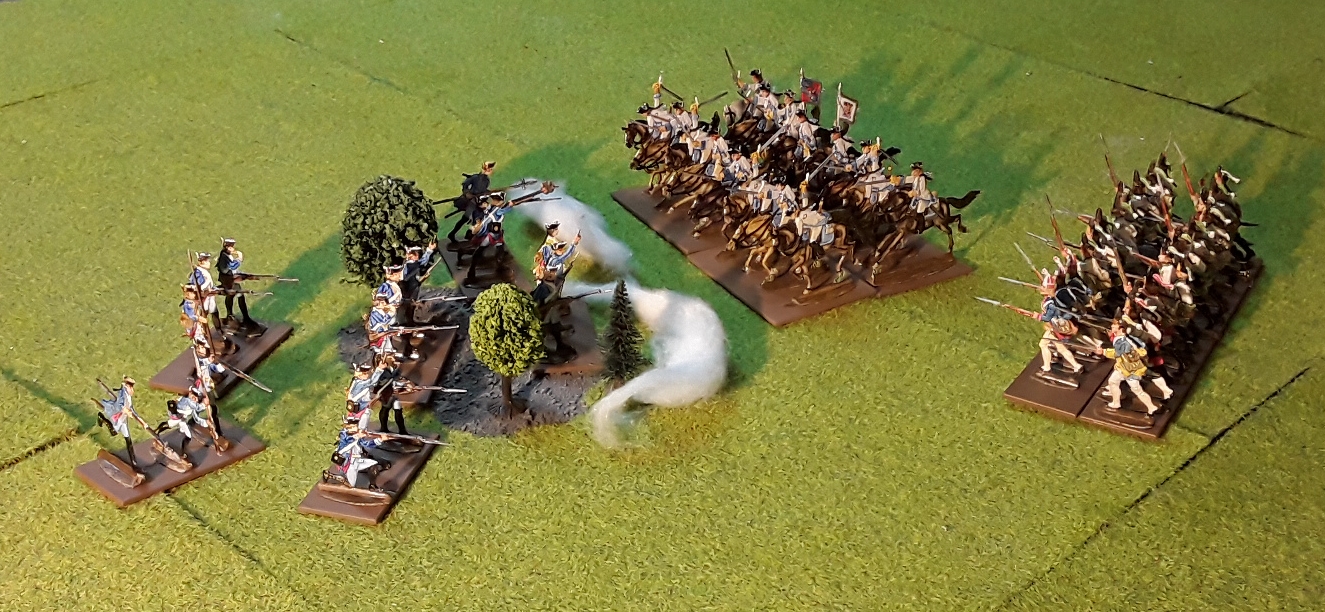
As the vanguard of the pursuing Empire troops emerges from the hills, the Ansbach Dragoons leading the column take a surprise volley from the Wunsch free bataillon that occupies the woods in front of the city walls.

Flank fire from the woods hits the Ansbach Dragoons leading the Empire vanguard
As the Dragoons mill about, trying to decide between attacking the infantry in the woods or continuing their advance, the first Prussian bataillons  in the town wake up from the infantry fire and start forming up. The first to march out are the Salmuth Fusiliers.

The Empire vanguard tries to push ahead and shatter the Prussians as they march out of town. However, the first Prussian Fusiliers form line in time to receive the cavalry charge with a clean volley and push the Dragoons back.

Ansbach Dragoons charge the first Prussian infantry showing up, just to be beaten back

Some Grenadier officers of the Willemey combined bataillon seem to have spent the evening gambling and drinking, they are definitely slow to wake up. Heads will be rolling when this skirmish is over...
Although the Prussian infantry take ages to form up, enough men march out of town to block any advance of the two batallions leading the Empire vanguard (Ansbach Dragoons and the combined Grenadier batallion).

More Prussians beginning to wake up and march to meet the enemy
The Prussian lines form slowly but in time to block the rest of the Empire vanguard. The Ansbach Dragoons charge repeatedly, being routed with some losses.

As the main body of the Empire vanguard starts to march on the table, a heavy firefight breaks out between the Wunsch Freibatallion and the Grenadiers.
With the Kurpfalz guard advancing on the right, and the Hohenzollern Cuirassiers on the left, a heavy firefight erupts in the central woods

With the Kurmainz infantry, the main body of the Empire vanguard starts to appear

The Empire Grenadiers continue to battle the Freikorps in the woods with little progress and a lot of time gained for the Prussians. 

In fact, the Hohenzollern Cuirassiers do push through an attack on the Prussian right wing, but with the Fusiliers in good order (the Empire's lack of artillery to soften them up shows big here) and supported by their Dragoons, the valiant cavalry charge hurts the Empire troops more than the Prussians.

A last view across the lines of battle before the Empirentroops decide to call it a day and disengage. On the left of the picture, the Prussian infantry managed to form lines just before being hit by a valiant, but unsupported charge of the Cuirassiers. On the right, the Empire Grenadiers are still stuck fighting the Wunsch Frei troops about to retire on their Jager company in the woods at the bottom of the table.
At this point the Empire calls it a day. With only three morale chips left, the Prussian line fully formed and the Empire main body still marching onto the table there is no way they will be able to brush the Prussians aside and progress quickly.

The army characterization built into Piquet made a big difference in this game, giving the Prussians more morale chips and an extra infantry move (which they desperately needed to wake up their sleeping troups), while the Empire barely got its minimum morale chips, and much less effective extra cards (reload and cav move), so they quickly got near their breaking point when the cavalry attacks failed to shake the evolving Prussian line.

The Prussian Fusiliers one-upped the Grenadier batallions by showing up early and beating back two cavalry charges. They will continue the retreat with heads held high until the next clash with the pursuing Empire troops.

Freitag, 14. September 2018

Anker: GK NF 14 city wall by Falk Gundel


I'll try to combine two modelling hobbies of mine by using an Ankerstein building as a backdrop for a miniatures tabletop game. 

When I made plans for projects with GK-NF 16, and a kind of "last hurrah" round of GK-NF 14 projects, I saw the Falk Gundel "city fortification" model from this CVA archive entry I immediately thought this might be a great backdrop for a tabletop miniatures game. 

It was great fun to build, and looks fantastic. 

As always, you can click on the pictures to enlarge them.

Vire from inside town. On the right you can see I used some stones from 16A to show a bit of city wall.

This was the most fun part to build - nice timber framing over the large city gate, and a small stairs leading up from the building on the right to the walkway over the small gate.

The whole ensemble with a renaissance facade building on the right, a small tower and the city gates in the middle and a large tower in the background. 

View from the outside

The covered walkway above the city gates
I built this fortification in a corner of my gaming table, as a backdrop for my next game of Piquet.

Empty gaming table awaiting the deployment of troops. Actually, one Prussian bataillon of the Wunsch Frei regiment and its Jäger company are already deployed in the woods in the bottom right corner.

By the way, combining Anker and flats is not a new idea, of course. See for example this old magazine with a picture on page 2. Nice.


Freitag, 29. Juni 2018

Anker: Bundesministerium


Here's another one of the nice CVA buildings from the CVA booklet with building plans for GK-NF 10 to 14, the nicely named "Bundesministerium für Freizeit und Hobby Berlin" (new office building for the, unfortunately fictional, "federal government secretary for Leisure and Hobby in Berlin").

Foundation layer with some distance keeping stones #60 to be removed later

The stairway is a bit fiddly, but a fun idea. Here it is still under construction.

This is the finished staircase, unfortunately it ends below half of the total building's height (not that I have any idea how to continue it higher up...)

Getting closer to the roof layer...

Now just the flat roof is missing

Building front with interesting decorative blue facade elements and a somewhat industrial looking exhaust pipe on the right

Side view with one of the large window fronts which are hard, but fun to build and also don't look too boring because of the differing window heights


Montag, 18. Juni 2018

Anker: Delling Church


Before ordering the next box, I decided to warm up with a few non-Richter builds for GK-NF 14. Here is one taken from the CVA booklet with building plans for GK-NF 10 to 14, the Delling church.

As expected from the pictures in the booklet, this is a wonderful bread-and-butter building, designed in a straightforward, nice and clean way. Simple subject, solid execution, and a very good use of the basic stones in the set (but no artificial use of the many small stones that are sometimes pressed into very optional, decoration-only roles to good or not-so-exciting results).

Starting the roof construction

A small set of stairs leads up to the entrance in the tower. A nice ledge in yellow structures the tower, another one in red holds the roof.
Note the absence of unnecessary decoration. Some of the tiny 79 and 80 stones are used for small windows in the roof - not very realistic but a nice way to increase the roof area with a limited amount of blue 45 degree stones.

The small arches play a realistic role for the windows / sound holes on the level of the bells.

Main entrance and facade, again with a simple form and structured with a few ledges in yellow and red.

Mittwoch, 13. Juni 2018

Anker plans


Inspired by a great Youtube channel for a more current brick building system (no names named :) I've started to make plans to pick up my Anker stones again.

Currently I have the GK NF boxes up to 12A, i.e. box 14. You can see the stones here and some buildings here.

So now the question is where to go next.

The easy thing would be to build more with 14. I already started experimenting with New-Series buildings (finding that I can improvise up to GK-NS 12 with the NF 14 stones).

I would also like to revisit the alternative / non-Richter plans for GK-NF 14, e.g. the ones here or here. The Delling church from the BiK (first link) looks really promising, some other models in that booklet look nice, too. From the other link, the Hotel could be interesting (simple but big), there is also a nice church and a row of old houses forming one whole (with a nod to the Lego modular buildings that retriggered my Anker itches...).

Looking through these plans, I also came across a GK-NF 8 tower which looks really funky and unusual. That might make a nice diversion.

P.S. the GK-NF 14 town wall from CVA could also be a great backdrop to my next tabletop game...

I could also revisit buildings from box 10 and 12 and extend them, e.g. adding floors, width or detail. That's another idea I had when looking at the Lego Modular Buildings - they cry out to be customized with simple additions, that should also be possible for Anker buildings. One inspiration is this nice addition to the "Holy Grail" of Anker aficionados, the Große Burg.

The next obvious choice is to get box 14A and build the new models offered by that (and then to continue with 16A, 18A and enter the gothic era...). This will also open up the CVA buildings for 16.

I'll also think about a way to showcase Anker stones in our local Kindergarten. Not sure which box to start with, though - der Kleine Gernegroß uses half sized stones which are too easy to swallow, so maybe the Starter Set is a candidate (also listed in other sources in case of availability issues). This has no small stones (each stone has at least two edges of at least one base length).

Samstag, 2. Juni 2012

Ankerbaukasten 14: Aufbewahrung

Heute hab ich nach dem Abbauen mal einen Schnappschuß von der Aufbewahrung der Steine bis 12A (also Kasten 14) gemacht - ich mache mir nicht die Mühe, immer wieder in die Originalverpackungen zurückzupuzzeln, sondern staple einfach alle gleichen Steine beieinander, nach Farben und Typen in die Kästen sortiert.

Sonntag, 5. Februar 2012

Ankerbaukasten 14: Rathaus

Im Januar haben wir mal einen Entwurf aus dem Onlinearchiv der Ankerfreunde probiert: das Rathaus für den Kasten 14.

Das Gebäude hat viele schöne Eigenarten: drei ganz unterschiedliche Gebäudeteile, leicht vorstehende Simse zwischen den Stockwerken und eine sehr fantasievolle Gestaltung der Dächer, die aus den vorhandenen Dachsteinen in GK-NF 14 fast die maximale Dachfläche rausholt.
Die Vorderansicht zeigt schön die Gliederung in drei Gebäudeteile, den Säulengang an der Front und den Renaissancegiebel am linken Gebäudeteil.

Die Rückseite ist etwas schmuckloser, aber auch abwechslungsreich.

Am Dach sieht man einige der kleinen Dachfenster, die einerseits durch Verwendung des Dachsteins 269 noch etwas mehr Dachfläche ermöglichen, andererseits endlich mal den winzigen Steinen 79-81 eine nützlichere Rolle geben als nur dekorativ auf irgendwelchen Simsen und Fensterbänken rumzuliegen.

Pfiffig auch die Gestaltung der hellen "Fenster" des Turmstübchens direkt unter dem Turmdach mit den schmalen Säulen 196.

Die einzige ästhetisch-statische Schwäche des Bauplans ist, dass an dem Turm oft vertikale Fugen durch zwei bis drei Steinlagen durchgehen, ohne überdeckt zu werden. Das ist man von den alten Richterschen Entwürfen nicht gewohnt, ist hier aber vermutlich der Preis dafür, dass die anderen sehr hübschen Gestaltungselemente bei begrenztem Steinvorrat möglich werden.

Freitag, 8. Januar 2010

Anker Freestyle: Säulenpalast

Noch ein Freestyleprojekt, das Jakob alleine aus den GK-NF 14 Steinen gebaut hat (mit ein paar Tipps vom Papa zu passenden Steinen etc.).

Hier der innere Teil von hinten.


Der gesamte Komplex von der Seite:

Eingangsportal mit Säulen und aufsteigenden Dachplatten rechts und links, im Hintergrund der Erbauer.

Rückansicht mit dem Hof, der den hinteren Gebäudeteil abschließt.

Anker Freestyle: Tempelanlage

In den letzten Ferien haben wir mit den Steinen aus GK-NF 14 Freestyle gebaut.

Allerdings haben Kilian und Jakob nicht drauflosgebaut, sondern vorher jeweils einen Plan gezeichnet:


Hier sieht man die Gesamtanlage, die rausgekommen ist. Das ursprünglich geplante Gebäude ist das links vorne.

Hier kann man es nochmal genauer sehen, eine gewisse Ähnlichkeit mit dem Plan ist schon erkennbar:

Hier nochmal die Gesamtanlage einschließlich ummauertem Friedhof von hinten.

Es kam also noch einiges dazu, vor allem eine zweite Kapelle und ein Torgebäude. Hier von vorne:


Und von hinten:


Sonntag, 4. Oktober 2009

Ankerbaukasten 14: Pavillon

Im Urlaub begonnen, aber erst jetzt einige Wochen nach den Ferien fertiggeworden: der große Ausstellungspavillon. Hohe Säulen und eine recht große Dachfläche:

Hier der stolze Miterbauer mit dem fertigen Gebäude:

Und noch zwei Gesamtaufnahmen.


Sonntag, 6. September 2009

Ankerbaukasten 14: Raubtierhaus

Die Kinder wechseln sich mit dem Bauen mit Papa ab, diesmal ist wieder der fünfjährige Jakob dran.

Beim Bauen mit Kindern sind die symmetrischen Baupläne ideal - Papa baut eine Hälfte und die Kinder können beim Bauen der anderen Hälfte Auswahl und Platzierung der Steine einfach vom Original abschauen und müssen sich nicht mit den Bauplänen rumschlagen.

Wir haben uns für das Raubtierhaus entschieden und es auch gleich mit einem Löwen und einem Nashorn bevölkert (die Figuren sind von Schleich), nachdem der Keller gebaut und überdacht war:

Hier das fertige Haus von vorne (allerdings ohne Schutzgitter für die Raubtiere :) und die sehr abwechslungsreiche Dachkonstruktion, die auch die neuen ganz schmalen Turmspitzen 293 aus dem Kasten 12A verwendet.


Hier die andere Seite mit dem Eingang. Das Treppengeländer ist ganz schön knifflig (nicht kindertauglich) und braucht die ganz schmalen Stäbchen, z.B. 80, mal nicht nur als dekorativ rumliegende Schmuckelemente oder Abstandshalter, sondern wirklich als tragende Bauteile.


Freitag, 28. August 2009

Ankerbaukasten 14: Aussichtsturm

Als drittes Ankerbauprojekt war Rebekka dran, sie hat sich den ganz hohen Aussichtsturm ausgesucht. Das ist eine ganz knifflige Sache.

Das Fundament sieht noch einfach aus, aber schon die Treppenstufen sind nicht so leicht:


Hier sind die roten Stockwerke schon fast fertig:


Jetzt kommt eine ganz kuriose Unterkonstruktion für das weiße Stockwerk, das sieht aus wie mit Holzbalken gebaut:


Inzwischen hat Kilian ein paar Wachhäuschen nach eigenem Entwurf gebaut:


Jetzt sind die weißen Stockwerke einschließlich Säulen fertig:


Und schon setzt Rebekka den letzten Dachspitzenstein:


Am Schluß haben wir noch die Geländer gebaut. Komischerweise haben uns einige Teile gefehlt, wir mußten an manchen Stellen improvisieren. Aber wir sind fertig geworden.


Der fertige Turm ist so hoch, dass er größer ist als Rebekka: